AI Crawler Trends in 2026: Search, Training and Agentic Access
AI crawling is no longer one activity. The clearest 2026 trend is the separation of model-training crawlers, search-indexing crawlers and user-triggered fetchers. Publishers need policies that distinguish these purposes instead of blocking or allowing every bot with one rule.
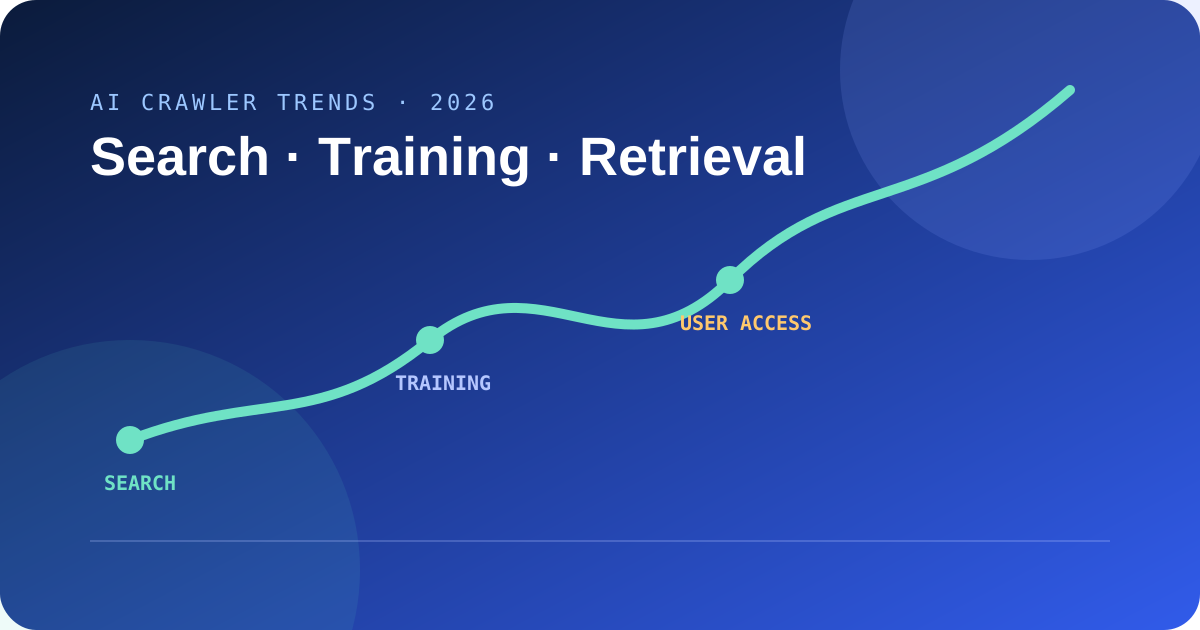
Operators use separate user-agent tokens so site owners can make different choices for training, search visibility and user-requested access.
Why are AI crawlers becoming more specialized?
Operators use separate user-agent tokens so site owners can make different choices for training, search visibility and user-requested access.
OpenAI documents GPTBot, OAI-SearchBot and ChatGPT-User as different controls. Anthropic similarly separates ClaudeBot, Claude-SearchBot and Claude-User. This makes a purpose-based robots.txt policy more accurate than a company-wide rule.
What changes for publishers?
A publisher can restrict model training while still allowing AI search discovery or user-directed retrieval.
Review each documented token, record its purpose and test the exact paths it can reach. Avoid assuming that a rule for one token automatically applies to every product from the same operator.
What should teams monitor?
Monitor robots.txt changes, crawler logs, indexability and referral quality as separate signals.
An allowed verdict proves only that a published rule permits a request. It does not prove crawling, indexing, training or citation. Combine technical audits with Search Console, analytics and server logs.
Practical checklist
Use these steps to turn the article’s principle into a repeatable publishing and measurement habit.
- Record the exact URL, crawler token and date before changing a rule.
- Separate a published directive from an observed HTTP response and from search visibility.
- Link to the relevant official documentation and state what the test cannot prove.
Frequently asked questions
Should every AI crawler be allowed?
No. The correct policy depends on the purpose of each bot and the publisher’s goals.
Does blocking a training bot remove a page from AI search?
Not necessarily, because operators may use separate search and training tokens.
Is robots.txt an access-control system?
No. Sensitive content still requires authentication and authorization.